

Sound Strategies
Four Valuable Lessons I have Learned Since Graduate School
Four Valuable Lessons I have Learned Since Graduate School
Robert J. Ward


LESSON #1: We teach best what we need to learn most.
LESSON #1: We teach best what we need to learn most.
The statistical probability that I would be here today is very small. First, there are so many gifted teachers and conductors in our business. Second, when I first started to take trumpet lessons in the fifth grade the band director—after the initial trial period—wrote a note to my parents saying, "Dear Mr. and Mrs. Ward: Having observed your son for the past four months it is my considered opinion that he exhibits little talent or aptitude for music and therefore I am recommending that he not continue in the school music program." And the next week a teary-eyed 5th-grader went to the band office and returned his shiny King-brand trumpet.
I guess I've never been good at taking no for an answer. Nor someone telling me I can't do something. This has always seemed to invoke a challenge to overcome. So, the next year I tried again. This time the process went easier and, while the playing was not much better, I was allowed to proceed through the program, ultimately resulting in my becoming a trumpet major at the University of New Hampshire.
The truth of the matter is that in the fifth grade I did not have the tools I needed to start the process of learning to play trumpet. In my hometown, in western Massachusetts, we had a weekly music activity period, and I remember fondly going down to Mrs. Gray's music room and singing while she played the piano. The message I must have received is that music is enjoyable. What was not provided was that music literacy was a requirement and that practice was a necessity.
When I started the boys choir in Oklahoma it never occurred to me that this was perhaps a way for me to heal my wounds of the past. On the surface, I thought I started the program to carve a niche for myself in Oklahoma and eventually achieve tenure. I wonder, 35 years later, if one of the reasons I started the program was because I wanted to mend my wounds of the past. In the university choral ensembles Casey Cook and I conduct, we meet students who love to sing but who have not been afforded the opportunity to learn to read music. Maybe their school music program was like mine - an enjoyable experience but with no musical education. I choose to be the teacher who fuels their failed start, I teach best what I most needed to learn, and this awareness of having come full circle is gratifying to me and provides me with the energy necessary to continue.

Advertisement
LESSON #2: I cannot save the world
LESSON #2: I cannot save the world
Several years ago at a summer convention I met a woman—whom I'll call Tracey. Tracey had just finished a respectable performing career and was about to embark on her first year as a public-school music teacher. I gave her my business card and asked her to write to me and describe her first few months in the classroom. The first email arrived in September, filled with everything I expected. I quickly wrote back and encouraged her to not be deflected from her course. I told her that I believed in her as a person and as a teacher. Her second email arrived in November and it, unlike the first, caused me concern. In this second email she wrote the following: "I still wake up every day and say, Oh, I can't do this again today. How am I going to make it through this day? Maybe feeling like this means I'm not cut out for this. You know, sometimes I wish I didn't feel so much. I think that I have to get the message across to every kid or I'm some sort of failure."
The first issue is on the idea of saving the world. Where in our process of training music teachers do we communicate to them that they must reach every student? I know that early in my career I felt that way and to this day there are times when I wrestle with these feelings when a singer elects not to return for another semester. Lately, I have wondered why music teachers assume a greater burden than physicians? Physicians are taught that they can't fix all problems and that some illnesses are beyond a physician's power to heal. Senior educators can support early-career educators by helping them set achievable expectations around student engagement. Reassuring new teachers provides a healthier, more sustainable career path and helps retain talented educators in the profession.
Now the fact that Tracey had the capacity to feel and care is exactly why we want her in the classroom. But the flip side of this is that she tends to lose heart because teaching, by its very definition, is a daily exercise in vulnerability. Teachers teach about things they care about, and what we care about defines who we are. In his book, The Courage to Teach, author Parker Palmer writes that, "unlike many professions, teaching is always done at the intersection of personal and private life." We have all seen teachers who walk into a classroom and immediately distance themselves from the students and the subject matter—their words floating in front of their faces like the balloon speech in cartoons. But gifted teachers don't walk into a classroom and immediately tune out their internal world. In fact, it's quite the opposite. As choral conductors we share our thoughts, our stories, and our passion for music and the arts. And it is this very act of sharing that makes us vulnerable.
As a novice teacher I remember thinking that the arrows of indifference and judgment were sharp and their capacity for inflicting pain quite enormous. Now in the twilight of my teaching career, I find that those arrows still fly and that their tips are still sharp. But now the pain passes more quickly, and I am aware that the wounds are not fatal. Part of my longevity in this profession is due to veteran teachers who elected to share their stories with me. Sharing stories is a special gift because they remind us that we are not alone. Hearing that others have endured the same arrows and that others experience crises of faith lends the perspective that arrows are a natural part of being vulnerable in a public arena.
I think part of the problem results from the fact that as children we all read the same books, and they all ended with the same final sentence; "And they lived happily ever after." In his best-selling book, The Road Less Traveled, author Scott Peck makes the statement that one must fall out of love before real loving can begin. Until we lose the fantasy of who or what someone or something might be we will never be able to live comfortably and successfully. Like young couples that discover marriage is much more work than they imagined, so young teachers must work through their idealized reality of day-to-day teaching. And as the transition from idealization to realization takes place both the young married couple and the young teacher depend on the support of a community. As members of OCDA may we use our position in this community to mentor the newest members of the community. Talk to them, listen to their stories, and share your own. Let them know they are welcome and that when their resolve becomes unsteady there are people who can help so that they will not be deflected from their course.
LESSON #3. Sometimes you have to stop listening in order to hear the music.
LESSON #3. Sometimes you have to stop listening in order to hear the music.
Physicians have many machines that enable them to become medical engineers, and choral directors have learned well the tools of the trade for aligning vowels and rhythm. What we tend to forget is that both the physician and the musician are healers; one heals the body, the other the soul and the spirit. Singers come to our rehearsals to be fed, both spiritually and musically. They freely bring to us their good will, their desire to perform to the best of their ability, and their love of singing. Unfortunately, not all singers possess the same talent for producing a pretty tone. However, each singer has the same basic need to feel affirmed, appreciated, and valued. Too often choral directors become so engrossed in the details of the music that they forget for whom the music making is really for. I certainly encourage the pursuit of excellence, and I believe that the singers want to be challenged to perform at their best. However, there comes a point when the conductor must say to themselves, "I think we have reached the summit—we've gone about as far as we can go." Now some of those peaks will be higher than others. And when that happens—when the choir has a heart that is bigger than their tone—it is important to remember that sometimes you have to stop listening in order to hear the music.
LESSON #4. The shortest distance between two points is a zig-zag line.
LESSON #4. The shortest distance between two points is a zig-zag line.
Any high school geometry student will tell you that the shortest distance between two points is a straight line. I'm sure there is a theorem to prove that. But music is not about theorems or scientific proofs—music is about art—and art exists for its own sake without any need to prove its need for being. A challenging aspect of teaching in 2026 America is that students have come to expect neatly wrapped packages. They desire to come to class, to be informed as to what is important to memorize, and then to perform well on the test. This is the extent of their intellectual investment. Now to all the students who may be here this afternoon, please do not take this as an insult—because these same words were written in 1976 when I was an undergraduate. It is a normal part of the process, and anyone who has an investment in teaching knows that this is the true pedagogical challenge—to move minds from the facts to the level of insight. As a culture we have become very much accustomed to our daily dose of prepackaged food and prepackaged entertainment. In fact, in many ways the need to be creative is subtly being removed from our day-to-day existence. And yet the issues—political, economic, and spiritual—that face us in the world require a creative and resourceful mind. Students must be empowered with the ability to see truth where it exists. And this is where the value of music and the arts in general begin to play their part.
Few things of real importance to the development of the soul can be proved; important things must be felt and expressed. That is why people with things of importance to say tend to write poems or music—or in the case of our chosen profession, a combination of the two. Because music teachers teach about something that cannot be seen, touched, or proved, we are required to resort to the realm of metaphor. Metaphor is the immediate celebration of the experiences of life and the language of the soul. Music teachers must be willing to look anywhere and everywhere for examples and metaphors that might serve well in the rehearsal room or classroom. Teaching music, in its best sense, is leading students on a path of discovery both about themselves and about the world in which they live. To achieve this goal requires a willingness to take the high road and the low road, for indeed the gifts of the spirit do not come easily. The challenge for the teacher is to sneak up on the student from all directions, to envelop them in a circle of stories and ideas. When this happens - when the student is surrounded by ideas and imagination - it's a lot like a hug - and when that sense of security is established the learning potential is enormous. Music is about discovery and insight, and that requires a willingness to travel in other than a straight line.
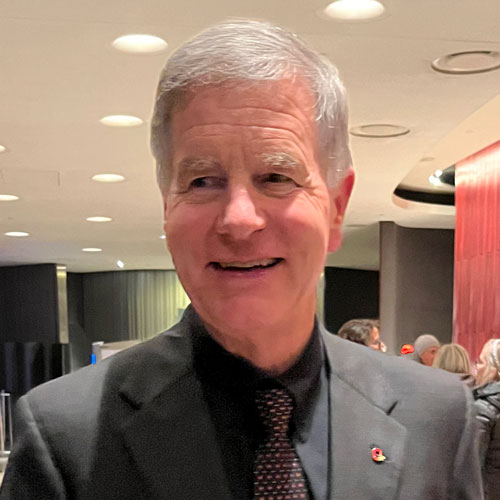
Dr. Robert J. Ward currently serves as director of Choral Studies at The Ohio State University where he conducts the Men’s Glee Club and Chorale. He also teaches courses in conducting and choral literature. Prior to his appointment at Ohio State, Dr. Ward was for sixteen years a member of the music faculty at Oklahoma State University.
©2026 Ohio Music Education Association